Homeowner Guide

Cost Guide

What does an epoxy garage floor actually cost?

The honest answer to what an epoxy garage floor costs is: it depends on your slab, and anyone who quotes you without seeing it is guessing — high to protect themselves or low to get in the door. We do not publish prices, and this page is why. What we can give you is everything that sets the number — the system, the condition of the concrete, the prep — so that when the written quotes land, you can read them like an installer instead of a target.

How epoxy floors are priced

Professional installs are priced by the square foot, and the system you choose moves the number more than anything else. The tiers below run from the most budget-friendly system to the most premium — grind, repairs, materials and labor all ride on that choice:

SystemRelative costWhere it fits
Solid-color epoxy$Clean industrial look, budget-conscious garages and basements
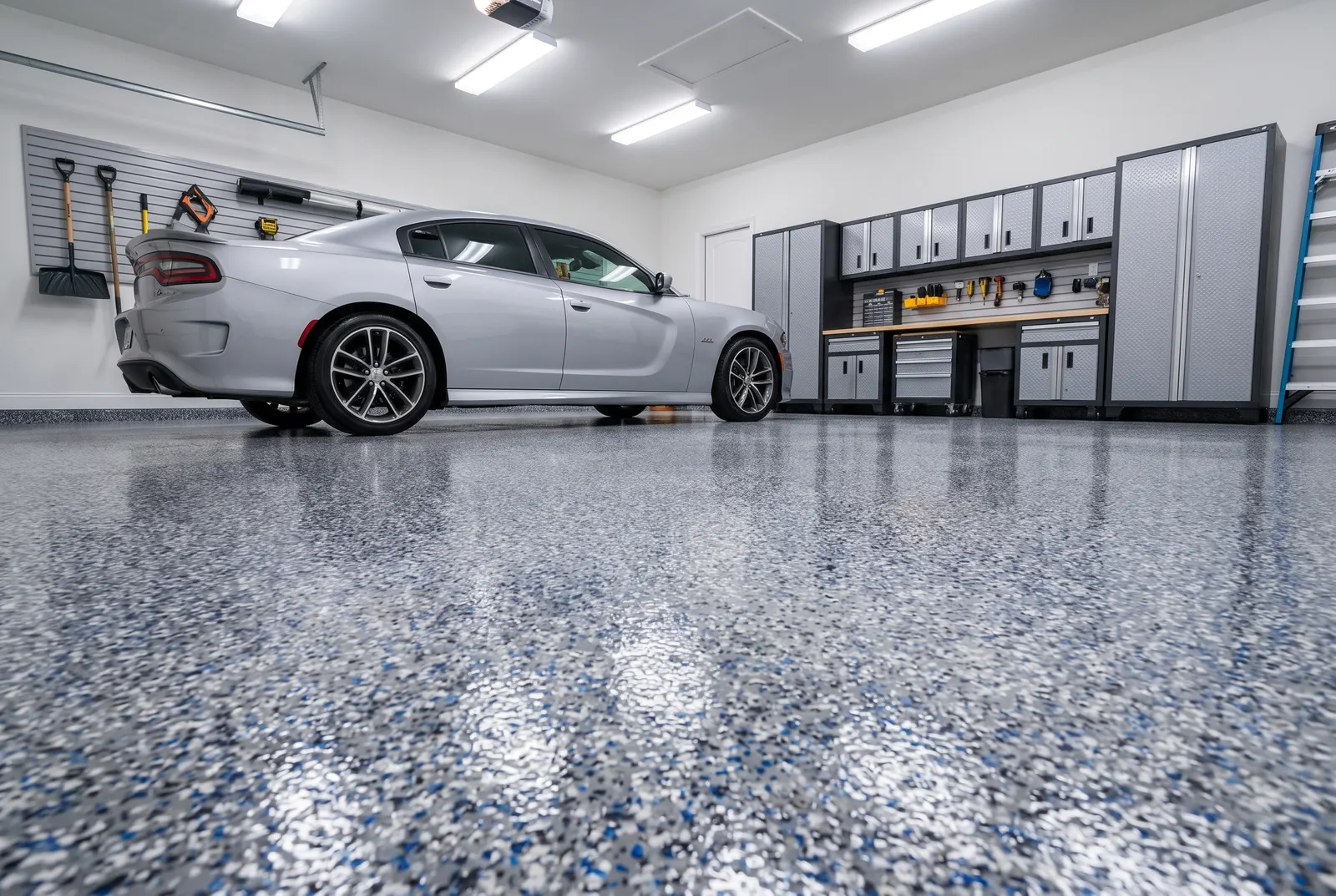
Full-flake epoxy + polyaspartic top$The standard premium garage floor — hides dust, adds grip
Full polyaspartic system$$One-day turnaround, UV exposure, commercial schedules
Metallic epoxy$$Showpiece interiors, finished basements, customer-facing space

Why we quote in person instead of publishing prices

Two identical-looking 2-car garages can be very different jobs: one slab is sound and dry, the other hides cracks under a failed kit coating and reads wet on the moisture meter. A number published on a website has to ignore that difference — which means it is either padded to cover the worst case or lowballed to make the phone ring, and both are a bad way to treat you.

So the number comes from the walkthrough: we measure, check moisture, count the repairs, and put the exact figure in writing. Larger floors do earn better per-foot efficiency — setup, mobilization and edge work spread over more feet — and that shows up in the quote too.

The walkthrough and the written quote are free, and the quote is itemized so you can see exactly where the number comes from — and compare it line-for-line against anyone.

What moves the number

  • Slab condition — cracks to rout and fill, spalls to patch, old coatings or glue to grind off. Prep is the honest variable, and the walkthrough is where it gets priced.
  • Moisture — below-grade or damp slabs need a vapor-tolerant primer. It adds cost; skipping it is how floors fail from underneath.
  • Size and shape — open rectangles coat efficiently; stairs, mechanical rooms and tight edges are hand work.
  • System and color — flake blends and metallics cost more in material and labor than solid color.
  • Season and scheduling — coatings need the slab between 50–90°F. Shoulder-season and after-hours commercial work carries scheduling cost.

Why the cheap quote peels

Every valley neighborhood has one: the floor that looked great for eight months and now sheds gray flakes near the tires. The pattern is always the same — no diamond grind (acid etch or nothing), water-thin material spread far past its coverage rate, and no moisture check. The coating never had a mechanical bond to lose. That is what a bid far below the others usually means: not a deal, a missing spec.

Grinding, repairs and honest material thickness are most of what you are paying a professional for. It is also why our quotes itemize the prep instead of hiding it — if two bids are far apart, the spec sheet will tell you where.

How to compare bids

  • Ask how the slab is prepped. The only right answer starts with mechanical grinding.
  • Ask for the mil build (coating thickness) in writing, and the actual products being installed.
  • Ask whether cracks and spalls are repaired, and whether moisture is tested — and what happens to the price if repairs grow.
  • Ask what the warranty covers, in writing, and who honors it.
  • Then compare the numbers. A fair bid survives those four questions; the too-cheap one usually does not.

Quick Answers

The short versions.

How much does it cost to epoxy a 2-car garage?

It depends on the slab, which is why we quote from a free in-person walkthrough instead of a website number. Square footage, concrete condition, moisture and the system you pick set the price — and the written quote is itemized, exact and free, usually within 48 hours of the visit.

What does epoxy flooring cost per square foot?

Installs are priced per square foot, with the system driving the rate: solid-color epoxy is the most budget-friendly, full-flake with a polyaspartic top is the standard premium floor, and full-polyaspartic and metallic systems sit above that. Your exact per-foot number comes from the free walkthrough, in writing.

Is an epoxy garage floor worth it?

If you use the garage at all, usually yes: it ends concrete dusting, wipes clean of oil and road salt, survives hot tires, and outlasts paint by a decade or more. The floors that are not worth it are the under-specced ones — which is a prep problem, not an epoxy problem.

The Services This Covers

Ready for the real thing?

Want the exact number for your floor?

Free walkthrough, moisture check, and a written itemized quote — the ranges above become one real number for your slab.